Welcome to Why History is Horrifying, a series we’re going to be dropping in on from time to time. These will be tales from days gone by to remind us that no matter how terrible things get, they can always be (and have always been) worse. So much worse.
Today, we’re going to take a dive into an old timey murder most foul, and touch on some British history. I know, you’re all super excited. But ahead of us, we have a murder that remains unsolved to this day, multiple conspiracies and intrigue, and a vill-aine of considerable regard.
The Perfect Victim Found
On October 17, 1678, a body was discovered on Primrose Hill in London, England. Lying face down in a ditch was Sir Edmund Godfrey, who had been missing for 5 days. Godfrey was a magistrate with a positive reputation. A decade earlier, he’d earned his knighthood by staying at his post during the Great Plague of 1665.
Godfrey’s own sword was sticking out of his chest, so even by 1600s “medical” standards, all could agree that he was dead. However, the sword hadn’t killed him. It was discovered that Godfrey had been so viciously beaten and strangled that his neck was broken. His sword had been stuck through his body after death. Ah—INTRIGUE!

There was no sign of struggle at the scene, so investigators (yes, they had investigators in 1678) determined that Godfrey had been murdered elsewhere and dumped here. And Godfrey still had his money and rings, so robbery had not been the motive. Ah—additional INTRIGUE!
So the mystery began: who had murdered this justice of the peace, and why?
Investigation Discovery: Medieval Murder would be allllll over this case.
First, Godfrey’s household was questioned. Godfrey only lived with servants at the time of his death. Three were interviewed for the inquest, and their collective opinion was that Godfrey died by suicide. Yep, somehow the 50 yr old guy had beaten himself Fight Club style so bad that he’d broken his own neck. Which, by the way, is physically impossible without a rope. And there was no rope at the scene. Maybe he used invisible rope? And I guess, because this is the 1600s, it was totally plausible that his spirit rose up from his body and ran himself through with his own sword. Yep. It all adds up.
But the servants had suspected suicide for some interesting reasons. To start, Godfrey had been sounding dark and paranoid before he went missing. He’d been referring to being violently martyred or assassinated. Yet he hadn’t made any additional security precautions or been helpful enough to say “I am afraid of being killed by Mr. X because Y Reason.” Hmm—even more INTRIGUE.
And to add to suspicions that Godfrey had done himself harm, by contemporary attitudes, he was a bit of a weirdo. Why? Because he liked to socialize with members of the working class. Gasp! And worse: he was Protestant but was friends with several prominent Catholics. The horror! Heck, he was even pen pals with a faith-healer named “The Stroker.” And no, I am not making that up. And I am demanding a Agatha Christie-esque murder mystery play featuring “The Stroker” be produced, posthaste.
But this was only the first frays of the tangled web that made up Godfrey’s complicated social life while alive. As it turned out, Godfrey was connected to important people and multiple major political schemes. So much so that his murder generated a suspect list a mile long, a 3-year long hysteria that gripped a nation, and the wrongful deaths of at least 22 people.
Twist 1: The First Conspiracy
Godfrey had a history when it came to “being involved in stuff that might get you killed.”
Years prior to his death, Godfrey had been a member of the Peyton Gang. What was the Peyton Gang? Well, it started out as badass as the name sounds.
In 1670, Protestant King Charles II of England had made a secret deal, the Secret Treaty of Dover, with Catholic King Louis XIV of France (the guy lucky enough to be played by Leonardo di Caprio in a very subpar movie).
King Charles basically goes to France and pitches this Secret Treaty of Dover, which is scandalous as all fuck: “Hey, I can’t help but notice that you guys really like the Pope are trying to take over the Spanish Netherlands. Here’s an idea: you pay me £230,000 pension for the rest of my life. And in exchange, I’ll give France a fuck ton of ships to take back the Netherlands. As an extra perk: I dissolve the Church of England, aka the biggest force of Protestantism in the world right now. I’ll convert myself—and thus all of England—back to Catholicism. All for the low-low price of £230,000 every year. It’s a deal for the angels! Eh? Sound like a plan?”
All of you who took AP European History are absolutely shitting yourselves right now, I’m sure.
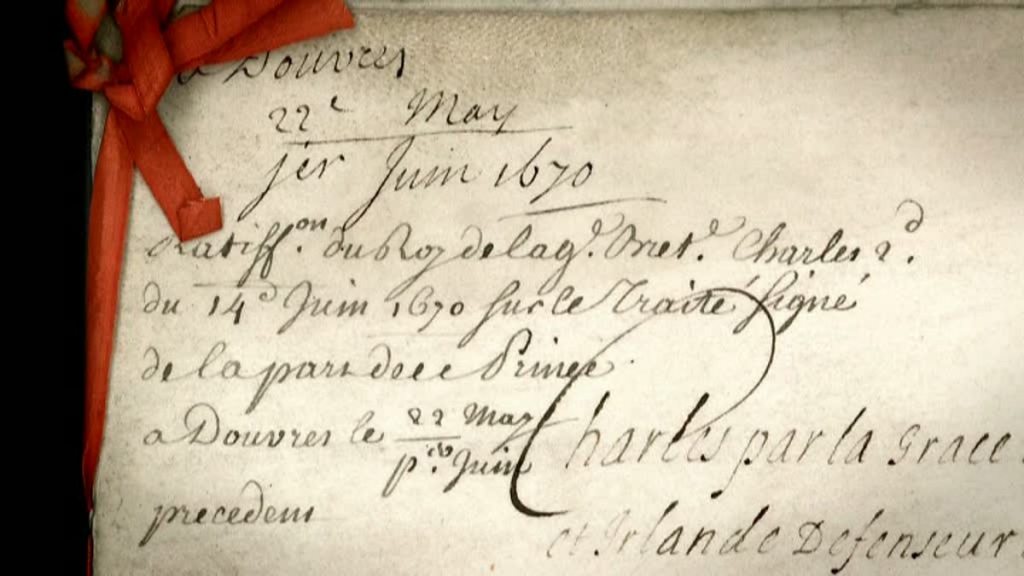
Because yeah, this was a Big Fucking Deal. The Protestant-Catholic issue was a Big Fucking Deal in Europe, but especially in England for centuries. And even by medieval “we burn women for being mouthy” standards, selling out your nation’s faith and resources for cold hard cash is impressively cynical and slimy.
Naturally, this “secret” treaty didn’t stay as secret as was hoped. Sir Robert Peyton, a member of Parliament, uncovers this outrageous deal. He’s having kittens about it. And by “having kittens” I mean “seriously discussing overthrowing the king and establishing a republic of England.” Yes, AP Euro History nerds, I too spat out my coffee upon reading that.
My speculative-fiction brain is squealing for someone to write up an 800-page novel all about this historical “what if?”
Peyton hand-picked 12 high ranking aristocrats and officials to discuss this extremely seditious plot. Sir Edmund Godfrey was one of these dirty dozen. Oh the INTRIGUE is ramping up hard!
Game of Thrones-level twists and turns here, right? Definitely this plot with a secret treaty and scandal and sedition had to do with this murder, right?
Well… similar to Game of Thrones… The wheels started strong and then farted to a stop.
The Secret Treaty of Dover remained a secret because King Charles II got used and abused by good ol’ King Louis. England committed to war with the Dutch alongside France in 1672. The people of England weren’t happy about it. They were even less happy about it when they got trounced on the battlefield. So, King Charles II never got his money and never dissolved the Protestant Church of England. Thus Peyton’s Gang never had its coup, thus being reduced to a burp of history.
So while the events 6 years prior to his murder added a lot of spice to his life’s story, it seemed the Treaty of Dover and the Peyton Gang were unrelated to Godfrey’s murder. But don’t worry: Godfrey had recently been involved in conspiratorial affairs of far greater relevance…and danger.
Twist 2: The Second Conspiracy
A few weeks before his death in October of 1678, Godfrey’s life had gotten walloped with intrigue. INTRIGUE.
In September 1678, a man named Titus Oates and his buddy Israel Tonges approached Godfrey to serve as an official witness to sworn statements about a massive conspiracy. Oates and Tonges (who are definitely releasing an easy-listening indie album next summer) claimed to have intimate knowledge of what came to be known as The Popish Plot.
A note re: pronunciation: that’s Pope-ish Plot, not Pop-ish Plot. I wish it involved a deadly scheme to get people to refer to “soda” as “pop,” but matters were far more serious than that.
The Popish Plot referred to a plan by prominent Catholics to assassinate King Charles II and replace him with a Catholic ruler—his brother, James. Yep, more of that whole Protestant-Catholic bit. It’s a Thing.
But ya know what isn’t a Thing? This plot being real. It was total bullshit from start to finish—but had very real, fatal consequences.
See in the years before “discovering” the Popish Plot, Oates and Tonges had written reams of anti-Catholic pamphlets. Wow! What a weird coincidence!
And they could name a whopping 541 Jesuit Catholics who were all in on this assassination scheme. Nothing says “totally telling the truth” like “a super-secret conspiracy that involves half a thousand people.”
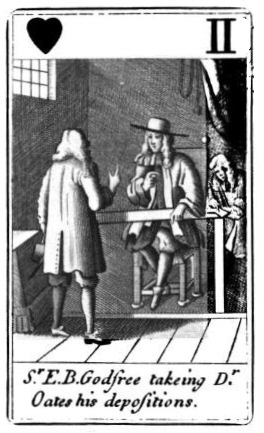
Godfrey took depositions from Oates and Tonges two weeks before his body was found.
Oates had then continued to bring “evidence” forward like conspiratorial letters (that he totally didn’t forge). He impressed investigators with his confidence and “remarkable” memory of events. Yep, it’s amazing how confident you can be and how great your memory is when you’re just making shit up.
Yet Oates wasn’t gaining the traction he’d really need to set off massive anti-Catholic hysteria.
…until the magistrate who’d taken his 100% true and accurate deposition, Sir Edmund Godfrey, was found murdered.
Oates pointed to this deed as proof of the Popish Plot’s existence. Things devolved very quickly afterwards. For starters, Oates—on account of being so trustworthy and knowledgeable about this definitely-real plot—was given a squad of soldiers and sent to just round up Jesuit Catholics.
The anti-Catholic panic that followed would be known as “Godfrey’s Autumn.” And it’s genuinely a bummer, because Godfrey was obviously a friend to Protestant and Catholic alike.
Twist 3: The Scapegoats
After Godfrey’s murder and the push for the Popish Plot “offenders” to be caught, in October 1678 King Charles II banished all Catholics from within a 20-mile radius of London. Catholics of any sort were at risk of being hassled, fined, and / or arrested for Existing While Catholic. Catholic clergy were particularly liable to get arrested, as authorities wanted to catch any Catholic that might know something about this totally-legit Popish Plot.
A contemporary writer said it was like “Hell has been opened” with how much people were freaking the fuck out. Both Protestants and Catholics carried guns if they had to go out at night. They must’ve been desperate, because you know nothing says “ungainly” and “as likely to kill me as it is an attacker” like a firearm circa 1678. Catholic houses were searched for guns and gunpowder. If you were a Catholic widow, you married an Anglican to feel protected. Even Anglican Fred, and no one likes Anglican Fred.
In November of 1678, Guy Fawkes Day occurred. For those not in the know, Guy Fawkes Day is a super fun regional holiday that involved burning effigies of a historic terrorist and totally isn’t frightening propaganda that stretches even into the 21st Century. And no, I’m not making a V for Vendetta reference because fuck you, edgelords. Anyway, on Guy Fawkes Day 1678, people burnt effigies of the pope. Which, granted, of Sinead O’Connor had done, I would’ve been onboard with.
Later that month, a far less colorful but really significant event occurred: Catholics were barred from Parliament. That law stayed on the books for 150 years. That’s how bad Titus Oates’ shenanigans fucked over the Catholics of England.

Soon, more conspiracies about the Popish Plot popped up. These included that Catholic assassins were going to shoot King Charles with silver bullets and that high-ranking Catholic aristocrats had signed a Blood Oath of Secrecy. …honestly if Catholicism were more like episodes of Supernatural, they’d probably retain more followers. I wonder if “The Stroker” is canon in that universe?
Nowadays, we would call these Great Big Red Flags of Potential Genocide. And indeed, convictions and executions of “treasonous” Catholics, particularly clergy, followed. This would eventually claim at least 22 lives. Three of which were the men wrongfully convicted and executed for the murder of Sir Edmund Godfrey.
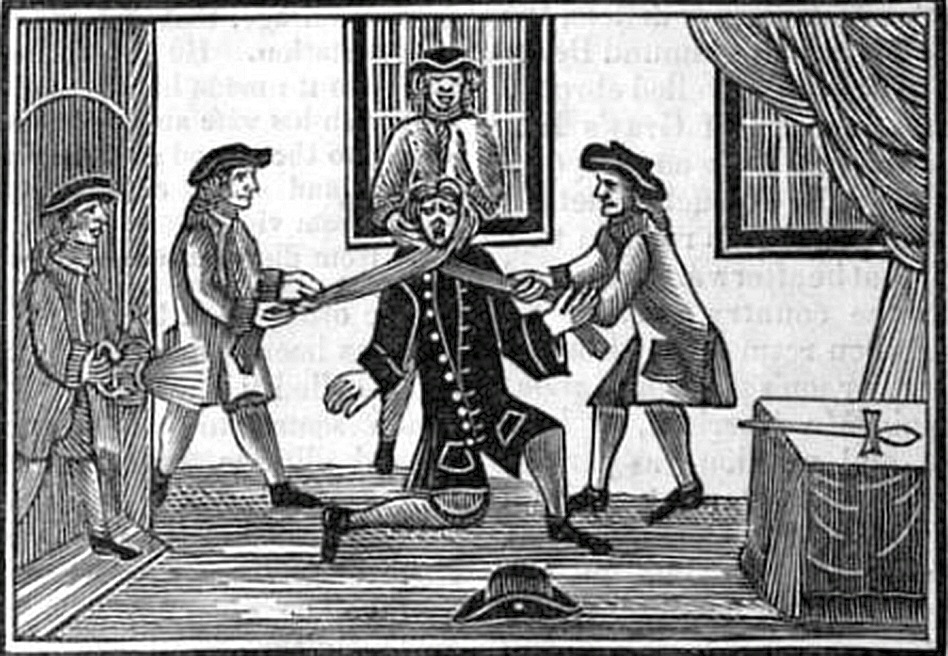
The men eventually convicted for Godfrey’s murder were Lawrence Hill, Henry Berry, and Richard Green, three Catholic workmen. In December 1678, two months after Godfrey’s murder, they were basically picked at random as the perpetrators by a man named Miles Prance. Prance had been a Catholic #SocialJusticeWarrior publicly protesting against the Popish Plot hysteria. For that, he was arrested and tortured under suspicion of being involved in the Godfrey Murder. Thus, Prance “confessed” and recanted his knowledge of the Godfrey murder with more contradiction than your favorite oxymoron.
Why “The Stroker” wasn’t picked as a super-convenient scapegoat is anyone’s guess.
Prance’s story was: Godfrey had been ‘harassing’ three Catholic clergyman (two of whom apparently never existed). Weird, since Godfrey was known for being amicable with clergy of all stripes—or “strokes” in one case. The three priests somehow lured Godfrey to a house and got the three workmen to murder him. And then they held onto the body for a few days for….fun? And then they ran the body through with a sword for…fun? And dumped it in a ditch for….fun?
Hill, Green, and Berry (a cottagecore band releasing their new single on Spotify any day now) were arrested and convicted. In February 1679, the three men were hanged on a hill overlooking the very spot where Godfrey’s body had been found the previous October.
In spite of the Godfrey case being temporarily closed, the Popish Plot anti-Catholic hysteria, jailing, and executions would burn on until 1681.
From post-Godfrey’s murder until the ending of the Popish Plot hysteria, one particular individual benefitted a great deal. Ol’ Full of Shit Titus Oates got to enjoy his personal anti-Catholic good squad, an apartment, and a salary.
So naturally, ala Game of Thrones-level INTRIGUE, Oates is a good potential culprit in Godfrey’s murder. And yes, Oates is a historic vill-aine who did in many ways “get away with murder.” Godfrey’s murder was a total boon to his evil-as-fuck cause. But historians haven’t pointed to Oates as the likely murderer in retrospect. Oates was great at reactionary villainy, but he seems to have lacked the Machiavellian skill to pull this off. Oates wasn’t even a very good liar, he just happened to have an audience eager for an excuse to destroy Catholicism in England.
As far as what happened to Oates in the end? Once the Popish Plot excitement died out and in many ways was revealed as fraud, he lost his goodies and was put on the street. Oates then made the very stupid decision to publicly complain about the King, so he was arrested for sedition. A few years later, while still in prison, he was charged and convicted of perjury for all the bullshit he peddled for 3 years of the Popish Plot hysteria. That perjury conviction won him some lovely prizes: getting whipped through the streets of London twice, imprisonment, and being pilloried in public once a year for every year he was imprisoned.
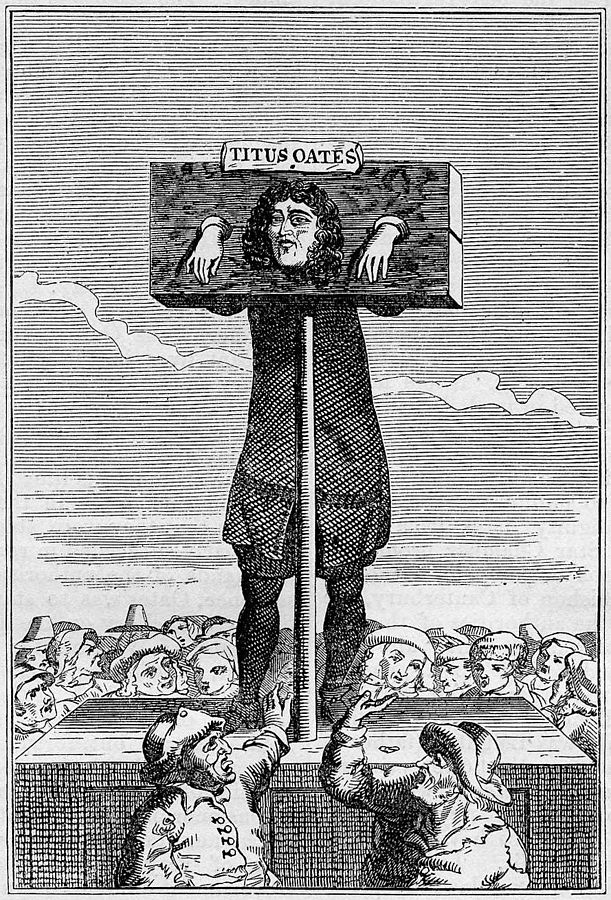
Given Oates’ obvious untrustworthiness: contemporaries quickly came to the realization that Sir Edmund Godfrey’s murder remained unsolved.
Enter the Perfect Villain
Centuries later, we have new leads on the case. For who could provide a better forensic mind to this medieval British murder than an American detective fiction writer? John Dickson Carr was a “Golden Age” detective-noir writer who dipped into nonfiction occasionally. In 1936, he published a historical analysis of the Sir Edmund Godfrey murder.
Carr took the case back to basics: who is the most likely suspect when a member of the court is murdered? Someone who was on the bad end of the criminal justice system.
Were there any particularly suspicious characters that Godfrey had prosecuted in the past? Perhaps someone with a violent history? Maybe someone who screams “DANGER” louder than that Electric Six song and has been enabled by the aristocratic power structure to literally get away with murder? What about a suspicious member of the aristocracy who has gotten away with multiple murders?
Why what a coincidence: there was one such person available as a suspect.
Meet Philip Herbert, 7th Earl of Pembroke and 4th Earl of Montgomery. Yep, two earldoms to his name! Very fancy.

Between 1652-1683, Herbert managed to squeeze in an awful lot of violent shenanigans in his 30 years on this planet. Philip Herbert was a member of a line of “Philip Herberts,” some of whom suffered “mental instability.” But our Philip Herbert outdid all of them in terms of violence and instability. He was known as “The Infamous Earl of Pembroke”—which admittedly sounds as chilling as “The Infamous iHOP of Pembroke.” By 1678, Herbert was a known drunk and violent man who’d already nearly killed a man in a duel. But 1678, the same year Godfrey was killed, really was Herbert’s golden year.
| Month in 1678 | Herbert’s Offense | Herbert’s “Consequences” |
|---|---|---|
| January | Committed ‘hardcore’ blasphemy in front of the king. | Spent 2 days in the Tower of London, politely asked to be released, and was released. |
| February | Assaulted a guy in the middle of the street. | Ordered to pay a fine and politely requested that he “keep the peace.” |
| February | Compelled to do the opposite of “keeping the peace” and beat a man to death in a tavern. | Charged with murder. His fellow aristocrats found him guilty of manslaughter. BUT used a bullshit legal right called Privilege of Peerage to get off. “Privilege of Peerage” basically meant “I’m one of the rich and powerful, so I get one ‘do whatever the fuck I want Get Out Of Jail Free’ card. |
| Unknown Month | Almost beat to death Charles Sackville, the 6th Earl of Dorset who was a libertine fop known for his “gaiety and wit.” | None I could find. |
Yep, Infamous Herbert was having a very busy year. And the magistrate who inconveniently prosecuted him for murder? That was Sir Edmund Godfrey.
DUN DUN DUNNNN.
The detective writer, Carr, then pointed out some similarities between by Herbert’s next proven murder and the unsolved Godfrey murder. In 1680 during yet another drunken brawl, Herbert murdered an officer of the watch by running a sword through him—just as was done to Godfrey post-mortem.
By the by, Herbert got away with this murder too. Since “Privilege of Peerage” can only be used once as a defense, Herbert just fled the country for a bit until his aristocrat buddies successfully rustled up a royal pardon up for him.
The Evil Earl had motive and capability in the Godfrey murder. Not only was he capable of killing and happened to like killing people using the same means (vicious beating and swords), but he had no compunctions about attacking high ranking members of his own class or the judicial system. Seems like a mighty fine suspect.
Heck, he even kept a menagerie of beasts at his country estate like a James Bond villain. His collection included a lion, “some” bears, and 52 mastiffs. Have you seen a goddamn mastiff? They look like human linebackers in ill-fitting dog suits. Imagine 52 Ray Lewises with a bite as powerful as a lion (who happens to be their roommate), all at the command of a homicidal Lord Fauntleroy.

Plus, Herbert is said to have had about 60 goons at his command. Yeah, if a murder were committed in the same hemisphere as this guy, I’d have him on my suspect list.
The Perfect Murder?
The “Evil Herbert did it” theory of the Godfrey murder has been gleefully adopted by several modern historians. If you were to ask Wikipedia or such acclaimed sources such as The World Encyclopedia of Serial Killers, it would seem a universally accepted solution to a centuries’ old murder mystery.
So now I can see you, true crime fans, leaning in eagerly with big puppy dog eyes like “of course! It all fits so perfectly! It was the Evil Earl all along!”
Well….
Not so fast.
Let’s take a look at Philip Herbert as a character. He spells “subtle” with a hard “B.” Philip seemed incapable of committing violence without at least half a dozen witnesses present.

More so, Philip’s escapades proved that he had no need to be secretive of his crimes. The official channels of the justice system existed to protect rich royal fuckwads, even ones as fuckwad-esque as him. He apparently just needed to file the proper paperwork after every offense and it would be like nothing happened.
An important point made by some historians is that there is no evidence that any of the contemporaries to the Godfrey murder and Infamous Herbert’s crimes made a connection between the two.
Herbert had spent the first half of 1678 setting himself up as The Usual Suspect in any violent event within a stone’s throw of his name. He even earned the nickname of “Homicide.” Way to stay classy, aristocracy. The charges of his nickname-sake against him by Sir Godfrey weren’t secret—they’re a matter of public record to this day.
If, at the time, there were circumstances where it seemed the least bit plausible that Homicide Herbert was responsible…you’d think it would’ve come up in a letter, a diary, or the royal medieval version of NextDoor. Rumors of silver bullets being hoarded to kill the king were written down at this time—but not a single whisper of Homicide Herbert stabbing his prosecutor.
So in some ways, Sir Edmund Godfrey’s killing remains a Perfect Murder—it reaped chaos, cost lives, and yet remains unsolved in the pages of history.
INTRIGUE.
Like this article? Like this blog?
Show Why I Love Horror some love!
A small donation, just enough for a cup of coffee, is a little gesture that means a lot!
Your donation helps pay for this site’s domain. Plus, it’s a great thank you to Your Intrepid Host, the sole content creator for the blog!

 Why I Love Horror