Every Christmas season, I read the Charles Dickens’ classic, A Christmas Carol. It’s an easy task, as it’s only about 64 pages of text. I highly recommend that everyone read it, at least once, in its full original form.
As analyst Katherine Kroeber Wiley writes in a 2004 edition, “It is arguably one of the most artistic, least contrived, most psychologically correct, and brilliant of all [Dickens’] books.” Wiley also contends that, according to historic accounts, it was written in a single month and was a product of “the author’s complete outrage” about how society addressed—or rather, punished—poverty.
Why do I, a horror nerd, love it so much? Because A Christmas Carol is one of the all-time great ghost stories. It’s creepy, it’s dark, and in some ways it’s a little mean.
Consider the very first sentence of this Christmas story: “Marley was dead, to begin with.” Why, what a cheery way to kick off this holiday romp!
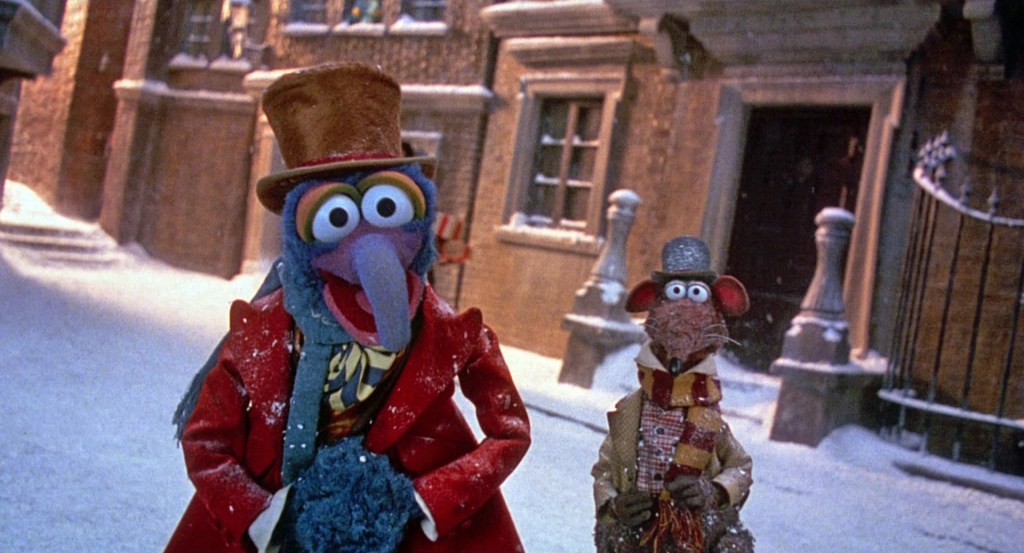
There is a lot of death in this story. It’s interesting how that both compliments and contrasts the Biblical Christmas story—a story of celebrating birth and everlasting life.
In many ways, this work is a tribute to the concept of memento mori—‘remember that you will die’—the idea that you should bear in mind that life is temporary. Memento mori was richly present in much of European culture and history, but the presence of and meditation on death has been largely scrubbed from 20th century culture. That might be why the more ‘gloomy’ text isn’t read as often in present day, and why the less complex TV or movie adaptations are preferred.
Dickens’ emphasis on memento mori hammers home the message to look to your fellow humans as fellow passengers to the grave. We are all headed to the same equitable end, and there is immense value in easing the suffering of inequity in life.
Dickens was someone who was intimately acquainted with poverty. And certainly, poverty and death are intertwined. But Dickens spends much of the novella emphasizing that death and suffering is hardly exclusive to poverty.
Aside from the philosophical motif of death, this story is creepy. And that makes the story more fun and instructive. The capture of dread, Gothic imagery, the dark supernatural, it all places A Christmas Carol squarely in the horror genre.
Consider the sequence of Scrooge arriving at his lonely home, frost and fog closing in around him. He is gradually beset upon by supernatural tidings. The door knocker briefly transforms into the face of his dead partner, Jacob Marley. A partner Scrooge spoke of just earlier that afternoon.
Scrooge is on edge as he enters the dark house (dark due to his own fault—as Dickens says, Scrooge prefers darkness because it is cheap). He imagines he sees a hearse in the corridors. An unused, abandoned bell in his bedchamber suddenly begins to ring. And then bells all over the house come to life. That’s when Scrooge hears, deep in the wine cellar, the sound of chains.
Something wrapped in chains is coming up the stairs….
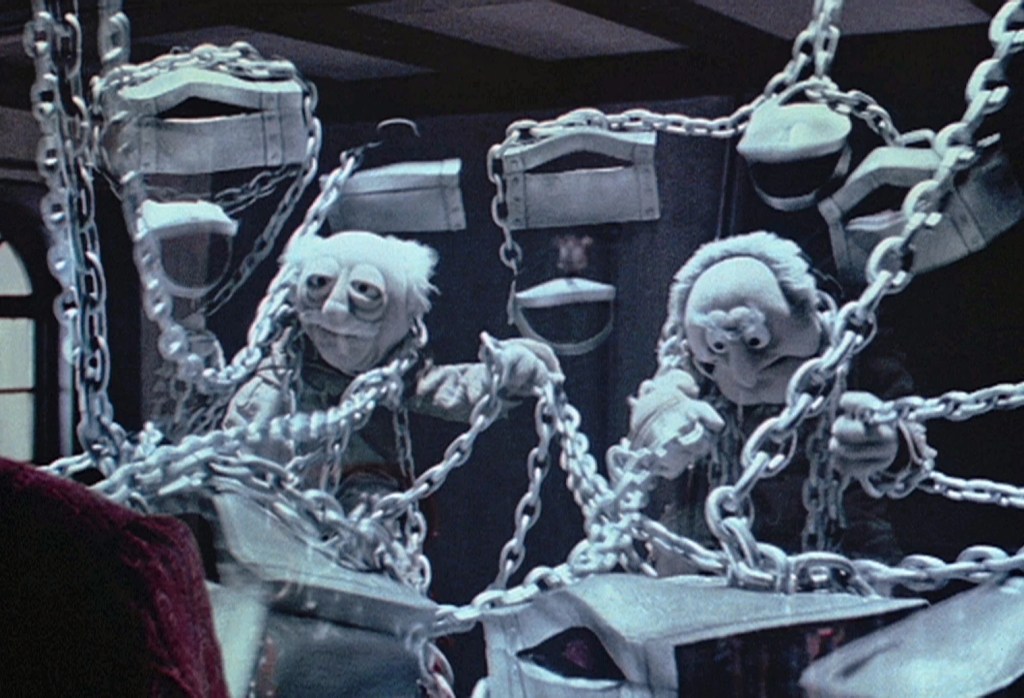
This is a set up worthy of the best haunted house sagas. We have this build up of dread, heightened by the fact that even this monumentally intimidating figure, Scrooge, is increasingly spooked.
Later, when we come full circle in Scrooge’s odyssey on Christmas morning, and he is dancing about “merry as a school boy,” Scrooge praises the knocker. He says he will “love it as long as he lives.” Intentional dark humor? Likely. Also terrifying to see a victim of a haunting praise of the tools of his torments? YEP.
Dickens aptly breaks up the Ghost of Jacob Marley’s creepy confrontation with dark humor—a good horror creator knows that to keep your audience engaged, sometimes it’s best to give them the release of a laugh in between bouts of building terror.
Marley is fettered in chains, further weighed down by ledgers and money boxes that he “forged” throughout his selfish lifetime. Not gonna lie, this was cathartic to read circa 2020 as our political leaders hem and haw about providing economic support, housing, and healthcare in the midst of one of the greatest crises every faced—but I digress.
The Ghost of Jacob Marley’s appearance and warning to Scrooge about the afterlife is one of the key “scary” areas that are key to grasping A Christmas Carol’s core morality tale. Yet it is often cut down in the easy-to-digest adaptations in media today. Marley delivers a vision of the afterlife that clearly borrows from Dante’s Inferno.
Marley reveals that each person is supposed to “travel” in life—not merely physically, but in their hearts and souls, to connect to the greater humanity around them. If they don’t, then they are doomed to be wandering spirits.
As wandering spirits, these phantoms are forced to see humanity suffer, and are tortured by their inability to help. In death, the spirits are wracked with remorse that they never bothered with in life. And they are trapped like this for eternity. Again, gotta say, in 2020 I found this gleefully apt. What I wouldn’t give to see Mitch McConnell feel bad about, oh, anything.

Marley explains to Scrooge that ghosts are everywhere, wailing in despair, at all times. How comforting! He even mentions that he’s been at Scrooge’s side many times in the years since he died, which Scrooge naturally is none too pleased about.
Marley is concerned about his old partner Scrooge suffering the same fate. So, like the good buddy he is, he’s gotten three ghosts to haunt Scrooge. Why don’t I have a friend awesome enough to send ghosts after me?
And then, on come the Christmas Ghosts! And in spite of the friendly, mystical ways 2/3 of them are presented in most adaptations, each of them is horrifying in their own unique way. And all of them are gothic kindred of memento mori—each of them dies at the end of their brief interludes.
The Ghost of Christmas Past is introduced by pulling back Scrooge’s bed curtains. But the text emphasizes that the curtains drawn back are those closest to Scrooge’s face.
“Scrooge found himself face-to-face with the unearthly visitor, who drew them as close to him as I am now to you.” That’s like something you say while telling a ghost story around a campfire!
The ghost is described as ‘like a child yet like an old man.’ Well that’s an unsettling image to conjure up. The Ghost of Christmas Past has a flame blazing out of its head and, weirdly, an extinguisher cap on hand. At the end of the interlude, Scrooge kinda murders the Ghost of Christmas Past with that cap, literally snuffing him out.

Through the journey into the past, we encounter more death. Scrooge’s sweet sister? Dead. His mentor Master Fezziwig? Definitely dead. We don’t know the fate of fellow apprentice Dick Wilkins, but Scrooge ominously refers to him as “Poor Dick.”
When we meet Belle, his lost love, she is in mourning dress—granted, a rather dramatic costume for a breakup. (By the way, Belle has a happy ending in the book, having forged a loving family of her own.)
After Scrooge murders the Ghost of Christmas Past, which is actually a great metaphor for the psychological phenomenon of repressing painful memories of our personal pasts, it’s time for the Ghost of Christmas Present to show up.
Oh goody! Fat, jolly, generous Christmas Uncle! Nothing bad can be found with this guy by our side!
The journey with The Ghost of Christmas Present introduces our damsel-in-distress of the adventure, Tiny Tim. We are told that the specter of Death is hanging over this poor kid. That’s what I need to complete my peaceful holiday: dying kids.
But that is not the end of horrors the Ghost of Christmas Present is here to dish out—in fact, he shows us even more depressing depictions of children in need.
As Scrooge is walking with the Ghost of Christmas Present, he sees something strange under the festive robe.
“…is it a foot or a claw?” Scrooge asks.
If you need to ask that question at all, it is time to stop asking questions and start running.
At this point, the Ghost of Christmas Present reveals that he has had two wretched children hiding under his robe the whole time.
The children, a boy and girl, are described as hideous, frightful, ragged, scowling, monstrous. They have been pinched, shriveled, twisted, torn to shreds. While they were once human, they have been morphed into menacing creatures.
Scrooge asks, “Are they yours, Spirit?”
A very important question to ask when you find two children living under a guy’s robe.
The Ghost spits back, “They are man’s. The boy is Ignorance. The girl is Want. Beware them both, and all of their degree.”
Ignorance and Want: they are monsters created by man, and therefore they are our responsibility. And they are a serious enough threat to humanity’s welfare that the Ghost tells us that Ignorance has DOOM written on his brow.
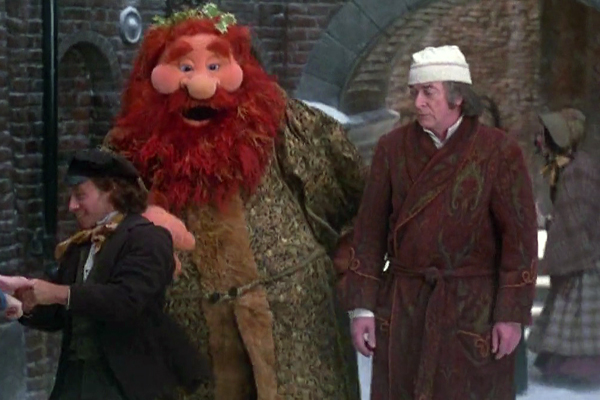
…oh, what’s that? You don’t recall this bizarre, terrifying scene from any version of this constantly broadcast Christmas classic?
Well it’s been cut out of almost all adaptations, except for the George C. Scott one, the Patrick Stewart one, and the Jim Carrey one (you are most forgiven if you missed that one in particular).
And it’s a damn shame. Because this “powerhouse scene,” as Wiley calls it, captures the essence of this morality tale. “Leaving it out is to ignore the driving force behind Dickens’ passion for the story.”
Why cut it out? Is it because it’s just too scary to present to kids? Or is it because that level of Real Talk is just too much for the jolly holidays?
It’s an important scene because this squarely lays out that Scrooge is not the sole Problem in this society. We are all at fault, we all have heavy lifting to do.
And with that, the Ghost of Christmas Present quickly ages and dies.
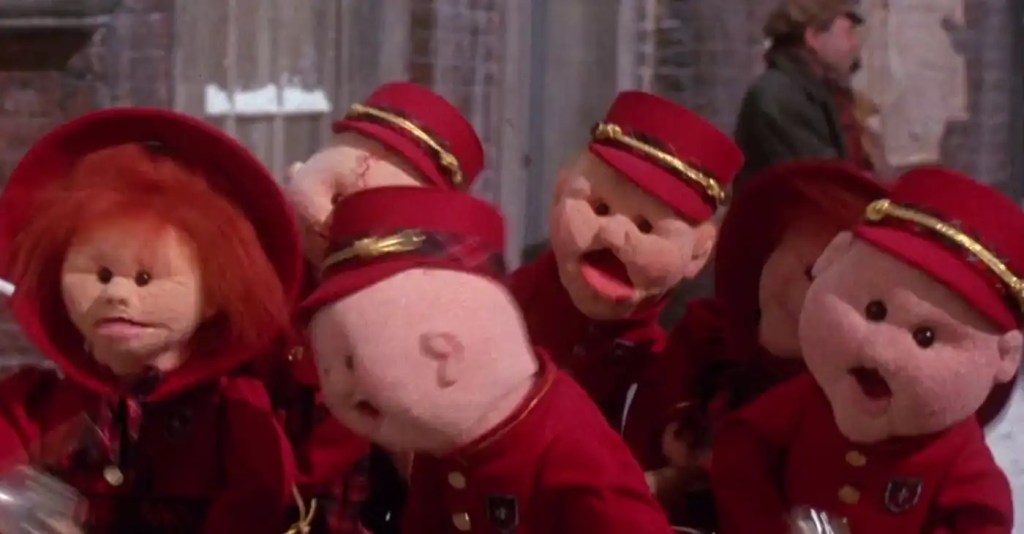
And now we get the most obviously terrifying of the ghosts: The Ghost of Christmas Yet to Come. Even after becoming almost comfortable with the presence of unearthly spirits, the Ghost of Christmas Yet to Come rightly frightens Scrooge. It appears in the style of the Grim Reaper, a dark, cloaked presence that exudes dread.
This voiceless, faceless ghost is the embodiment of the horror cliché of Fear of the Unknown. For what is more Unknown than the future and ultimately, death? Paired with that, the text makes reference to the spirit’s Unseen Eyes that Scrooge can feel upon him. The future is also the dark specter of Judgment.
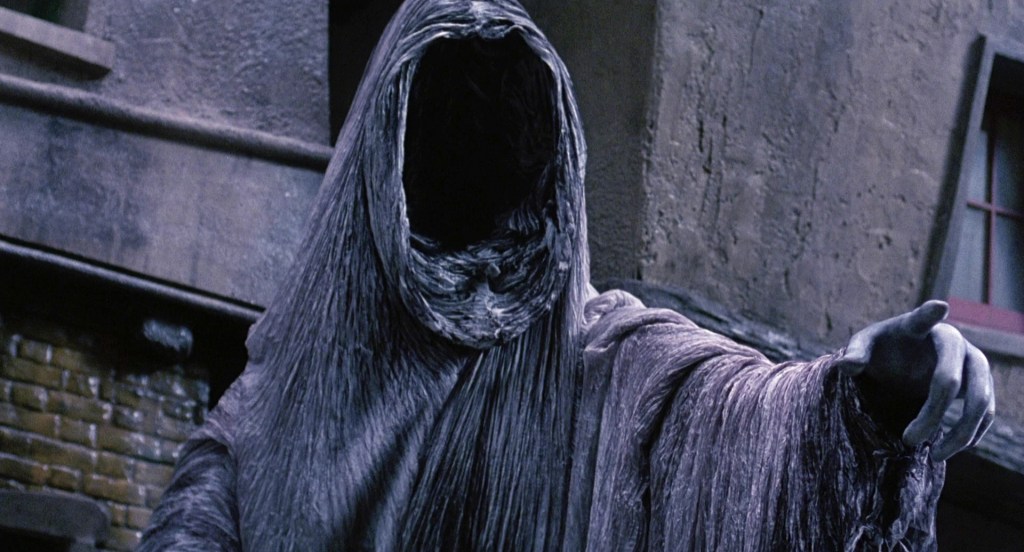
We then see the world of the future—perhaps only a year away. We realize, some of us quicker than others, that Scrooge is dead. Oh, also, Tiny Tim’s died, but that’s tragic and not nearly as drawn out or ghoulish. The entire fourth stave is dedicated to death. That’s all the future is, more or less: Death.
…
🎵 Just hear those sleigh bells jingle-ing, ring-ting tingle-ing, too🎵
We having fun?
Scrooge and the Ghost of Christmas Yet to Come enter on a conversation between local businessmen about the soon-to-be unattended funeral for Some *wink* Mysterious *wink* Unloved, Uncared for Businessman *WINK WINK*.
Scrooge is all “oh gosh gee, wouldn’t it be awful if when I died, people said they’d only come for the food?”
We then have this macabre scene of opportunistic servants-made-thieves arriving to pawn off stolen wares of the Mysterious *wink* Dead Guy *wink*. The shop is described as having masses of corrupted fat and sepulchers of bones. How, uh, cozy…
These wares have been stolen directly from the deathbed and the corpse itself. Horrid. But what’s sort of funny is that Scrooge is so in denial or so alienated from his own possessions and household, that he doesn’t recognize his own shit is being sold by his own servants. “Weird, where did my laundress get bed curtains that look just like mine?”
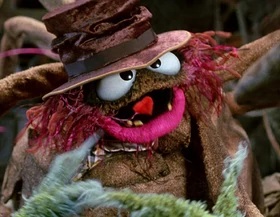
The spirit then takes Scrooge to the deathbed of the Mysterious *wink* Dead Guy *wink*. Scrooge can’t make himself look directly at the corpse.
But he does internally monologue in numb horror: “Oh cold, cold rigid dreadful death set up thine altar here and dress it with such terrors as thou hast at thy command; for this is thy dominion!”
METAL AS FUCK!
There are two particularly dark and cruel parts of this sequence, also often left out of other adaptations:
While viewing Scrooge’s neglected body in his dark empty house, there are the distinct noises of a cat and rats trying to claw or gnaw their way into the room to devour the body. So remember: make friends in this life, or no one is going to keep away animals trying to eat your corpse. A sound lesson for children everywhere.
Immediately after that, Scrooge is shown a husband and wife, who are indebted to him and positively joyful that he has died, thereby staving off their financial ruin.
Yeah, dunno why they left out the animals-eating-corpse bit or the explicit joy-at-the-death-of-another scene. Genuinely: I get that this is not kid-friendly, but fuck it. This is not a story for kids—this is a story for adults about what will happen to them if they do not better the lives of those in need. Let ‘em stew in a little terror for a brief moment.
We then get the revelation that, of course, Tiny Tim is dead. Yes, yes, very sad.
It provides a stark contrast to how Scrooge is mourned—or rather isn’t—versus how this deceased child brings bittersweet joy to others even after his passing. The scene also serves as a parallel to the earlier Cratchit Christmas we viewed with The Ghost of Christmas Present. While last year, Scrooge was called “the founder of the feast” by the charitable (yet poor) Bob Cratchit, this year he is not mentioned at all. Although the passing of his employer must have some meaning to Bob, it’s not worth a moment of thought that could be spent thinking of his departed son.

And then, the Ghost of Christmas Yet to Come literally spells out for Scrooge that he is dead in this future. Scrooge does everything he can to bargain and beg his way out of even looking at his neglected headstone, but inevitably must read his own name carved into the cold slab.
I’d say that’s the essence of horror: looking at your own tombstone.
But another strong aspect of good horror is hope, and Dickens grants that as well as redemption to Scrooge. How could Dickens not grant us hope from these gloomy phantoms’ exhibitions? Without it, his own, our own, society is DOOMed.
As Wiley writes, “Dickens saw the underlying attitudes that enable politics of any stripe” to ignore or dismiss the abundance and destructiveness of poverty. “Dickens hated nothing more than people who deliberately shut their eyes and pretended not to know or understand, in order to promote their already established attitudes.”
Again, my goodness, quite relevant to read about at the tail end of 2020 in America.
The text also emphasizes contrasts of expectations society has about poverty vs. wealth and the reality of it. Scrooge says Marley was a good man—of business. And Marley snaps back: “Mankind was my business! The common welfare was my business!”
Later, when the Ghost of Christmas Past is trying to urge Scrooge to follow it, it emphasizes that this is for Scrooge’s “welfare.” Here we have the irony: the financially secure Scrooge is in need of ‘welfare’, so to speak.
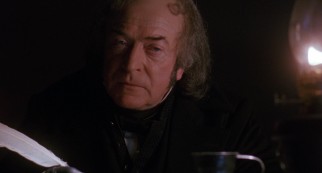
Horror is about a loss of control. It is profound, then, to see it wrenched so roughly from Scrooge, who holds tight control over everything around him. And what is a better experience of poverty than lacking control over your own future?
In addition, empathy and the concept of memento mori are grounded in humility, an experience aptly wielded in Dickens’ hands. “To hear the insect on the leaf pronouncing on the too much life among his hungry brothers in the dust!” laments the Ghost of Christmas Present, an outright counter to the then-budding anti-charitable ideas of Malthusianism and Social Darwinism.
2020 is the year to pick up this classic. We are in the midst of great crises, where Ignorance and Want seem to be more towering Godzillas than creatures who can fit under a robe. And Death and alienation have stalked us more closely than ever in recent memory. But crises can bring about great positive change, if we have the mindset and generosity of spirit to make it happen.
While it may not be comforting or cheery to think of your fellow humans as “fellow passengers to the grave,” maybe that’s the haunting perspective we need right now.

 Why I Love Horror