
“You’d better read the stories in this book while you are still feeling brave and before it gets dark.” – ‘More Scary Stories to Tell in the Dark’
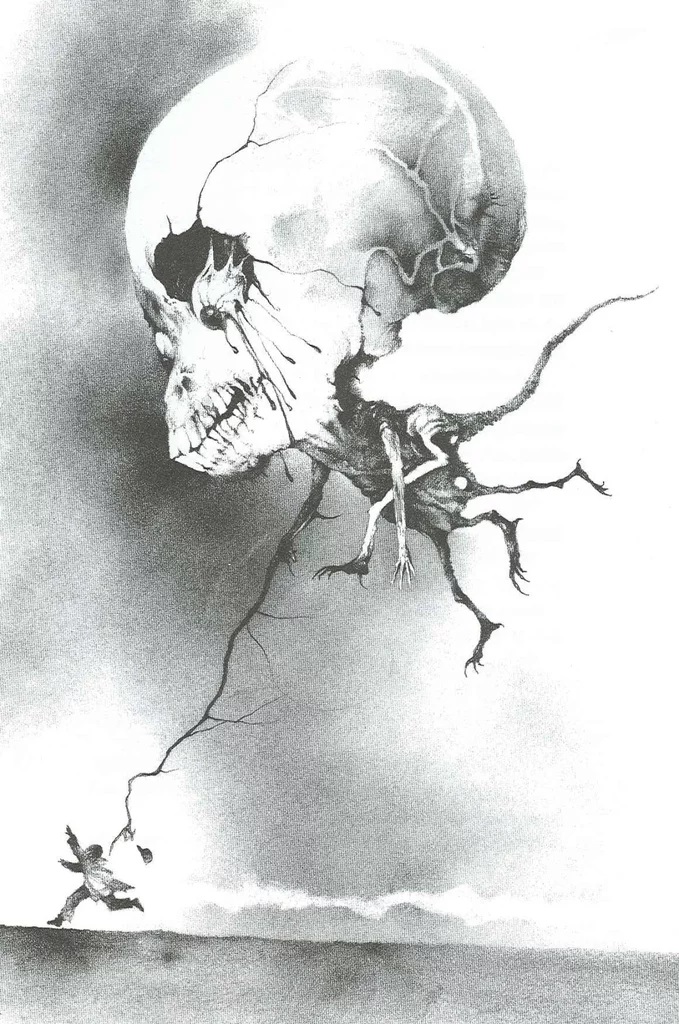
Of all the sacred artefacts for horror nerds of my generation, Scary Stories to Tell in the Dark is surely a divine trinity. The collection remains a perfect creepy casserole of Alvin Schwartz’s celebration of creepy folktales and Stephen Gammell’s notorious freaky artwork.
But like any self-respecting cool thing, Scary Stories attracted controversy and ire from many adults, who were determined to shame and ban the re-printing of tales that have been told for centuries. Between 1990-1999, the Scary Stories series were #1 on the list of the 100 most challenged library books in the US. In the 2000s, Scary Stories were still keeping their street cred by appearing in the top 10 most challenged books.*
Kids like scary stories. Parents like to ban scary stories that kids like to read. This is a natural cycle of Americana, borne of parents that are genuinely concerned but misinformed. This case has already been made perfectly by the Best PBS Kid’s Show Ever back in 1996. But, as a millennial, it is my job to wax poetic about nostalgia for 1500 words.
*Just a reminder of how it ruins everything, Scary Stories were unseated in 2010 by, yes, Twilight by Stephanie Meyer.
So why is it that parents fixate on banning or regulating media like books, movies, music, and video games for ‘the children’?
I will explore this from a 100% ‘not a parent perspective’, but in my defense: these parents are attacking these books from a 100% ‘pretending they never had a childhood’ perspective.
On the one hand, sure scary things scare kids and give them nightmares. I think some parents genuinely are pained when their child suffers even slightly from normal nightmares. To be blunt, parents are probably more annoyed than concerned. Kids having nightmares are an annoyance. No one likes getting woken up in the middle of the night, and sleep is a rare and precious commodity for a working parent. I can see why a concerned and sleep-deprived parent would turn on their wrath anything that would send a teary-eyed little Timmy into their room at 3am.
On the one hand, sure scary things scare kids and give them nightmares. I think some parents genuinely are pained when their child suffers even slightly from normal nightmares. To be blunt, parents are probably more annoyed than concerned. Kids having nightmares are an annoyance. No one likes getting woken up in the middle of the night, and sleep is a rare and precious commodity for a working parent. I can see why a concerned and sleep-deprived parent would turn on their wrath anything that would send a teary-eyed little Timmy into their room at 3am.
But I think it’s also a little more complicated than that.

Just some musings as an armchair psychologist (which means I’m not a psychologist, but I like playing one in real life):
When parents don’t understand why a kid would like a thing (scary stories, metal music, avocado toast), they react negatively. Maybe the ‘I don’t understand my kid’ thought subconsciously becomes ‘not understanding my kid makes me feel uncomfortable or like a bad parent’.
Maybe that discomfort transfers into ‘I am going to blame this material for the disconnect between me and my child’. And maybe that all comes out as “HERGABLERG VIDEOGAMES BAD.”
Here’s a perfect example from a 1993 article all about parents wanting to ban Scary Stories to Tell in the Dark:
“Why are we subjecting our children to this kind of violent material? … There’s a story called ‘Just Delicious’ about a woman who goes to a mortuary, steals another woman’s liver, and feeds it to her husband. That’s sick.”
Firstly, this lady gets the story wrong. In the story, the wife doesn’t go get a liver from a corpse just because she’s wants to try a new Paula Deen recipe. It’s because her abusive husband loves eating liver (the animal kind). But on this day, the wife doesn’t have a liver to serve and fears being beaten by her bastard spouse. In desperation, she takes the liver of a freshly dead person to serve instead. Maybe not the best or sanest decision to make, but it’s not corpse abuse for fun.
Weird how Mommy Self Righteous here is all up in arms about unique homestyle cuisine, but not wife beating. It’s almost like she didn’t actually read the story.
But the biggest issue is what she says at the start: ‘Why are we subjecting our children to this?’
I went to libraries fairly often as a kid. I’m sure you did too, dear reader. Do you ever remember a librarian grabbing you by the scruff of the neck and shoving a violent book in your face? Or even a nice happy book for that matter?
Libraries then and now are one of the few areas where as a kid you could self-direct wherever your weird, nerdy, curious mind took you.
Unlike video stores, there was no special curtained off area with all the Adult Content books (and if you are too young to remember such things, may I take this opportunity to call you a ‘whippersnapper’).That’s the power of libraries, and now the internet. You can look at and read about whatever you want and no one will stop you.*
*re: the internet, this is great but also probably our ultimate Doom.

No one is subjecting little Timmy to Scary Stories to Tell in the Dark. Little Timmy is subjecting himself to it. Little Timmy saw this on the cover of a book and said “ONWARD!”, because he is a little badass like that.
Maybe Timmy had nightmares, or maybe Timmy avidly read the book cover to cover. Mommy Self Righteous might be genuinely worried about the nightmares, but it’s clear that she cannot conceive of her kid having the free will to be attracted to a book like this.
These are parents that don’t have the imagination to realize that fear can be fun, or a good thing. Fear acted out through stories is a form of play. Play in social animals is practice for survival. It’s ‘fun stress’. Or the ‘pleasing terror’ if you wanna get kinky about it.
A misinformed/paranoid parent could see that disconnect and think “if this is what my kid thinks is fun…what else might they be into? How deviant is my child?”
But the truth is that it is the adult brain which is mature and exposed enough to the real world to make such leaps into deviant territory. It is the adults that hear old folktales of cannibalism and think “OMG this will turn my kid into Jeffery Dahmer”. If every kid who encountered these stories took that turn, we’d have to sell extra-large fridges to accommodate all the stored body parts.
I experienced this myself in my youth. Your Intrepid Host was middle school-aged, a misguided Hot Topic shopper, and fostering a budding love of things ooky spooky. After a summer afternoon in the library, my dad picked me up and I got in the car with ‘Rosemary’s Baby’ and ‘The Omen’ tucked under my arm.
My dad immediately started asking, basically, what was wrong with me. His mini freak out included repeating a story he heard ‘on the news’ about some satanic cult sexually mutilating its members.
My dad didn’t grasp that in both ‘Rosemary’s Baby’ and ‘The Omen’, the devil is still the bad guy even if he and his spawn win (whoops, spoilers). He didn’t grasp that his recounting of a (very allegedly) real story of violence was more disturbing to me than these fictional stories.
In his mind, my pop culture occult molehill had already become Satanic Mountain. It was embarrassing. It was shameful. And the only one damaging a part of our relationship at that moment was him, not me or the scary stories.*
*I’m a little disappointed I didn’t go on to create an evil Satanic cult. I feel like I didn’t reach my full potential.
As the late great Maurice Sendack once said:
“The fact of [a child’s] vulnerability to fear, anger, hate, frustration–all the emotions that are an ordinary part of their lives … to master these forces, children turn to fantasy: that imaginary world where disturbing emotional situations are solved to their satisfaction.”
And Maurice would know—he’d been through a lot of shit in his day.
For me, the most poignant aspect of Schwartz’s Scary Stories books are how he emphasizes the universality of sharing scary stories, how some of the stories include instructions on how to best tell the tale to friends to get a scare. He includes in every one of his books a bibliography about where these stories come from, how old they are, different versions, etc.
These scary stories represent ancient pastimes, from pioneer days and older. Telling scary stories is a deep running part of the universal human experience.
Sure, there are plenty of things we used to do to kids that we shouldn’t have. But sharing campfire stories isn’t one of them. If anything, adults have a responsibility to help children cultivate a healthy relationship with fear and with their individual ‘weird’ interests.

 Why I Love Horror

It’s never too late to realize your full cult-leading potential.
My parents regulated my exposure to most pop culture very strictly, but one thing for which I will eternally be thankful is that they never told me what I could and couldn’t read. (With the exception of the one Judy Blume book my mom hid in her drawer because it had sex stuff in it. She had not read any Stephen King when I was 11, but I had.)
LikeLike